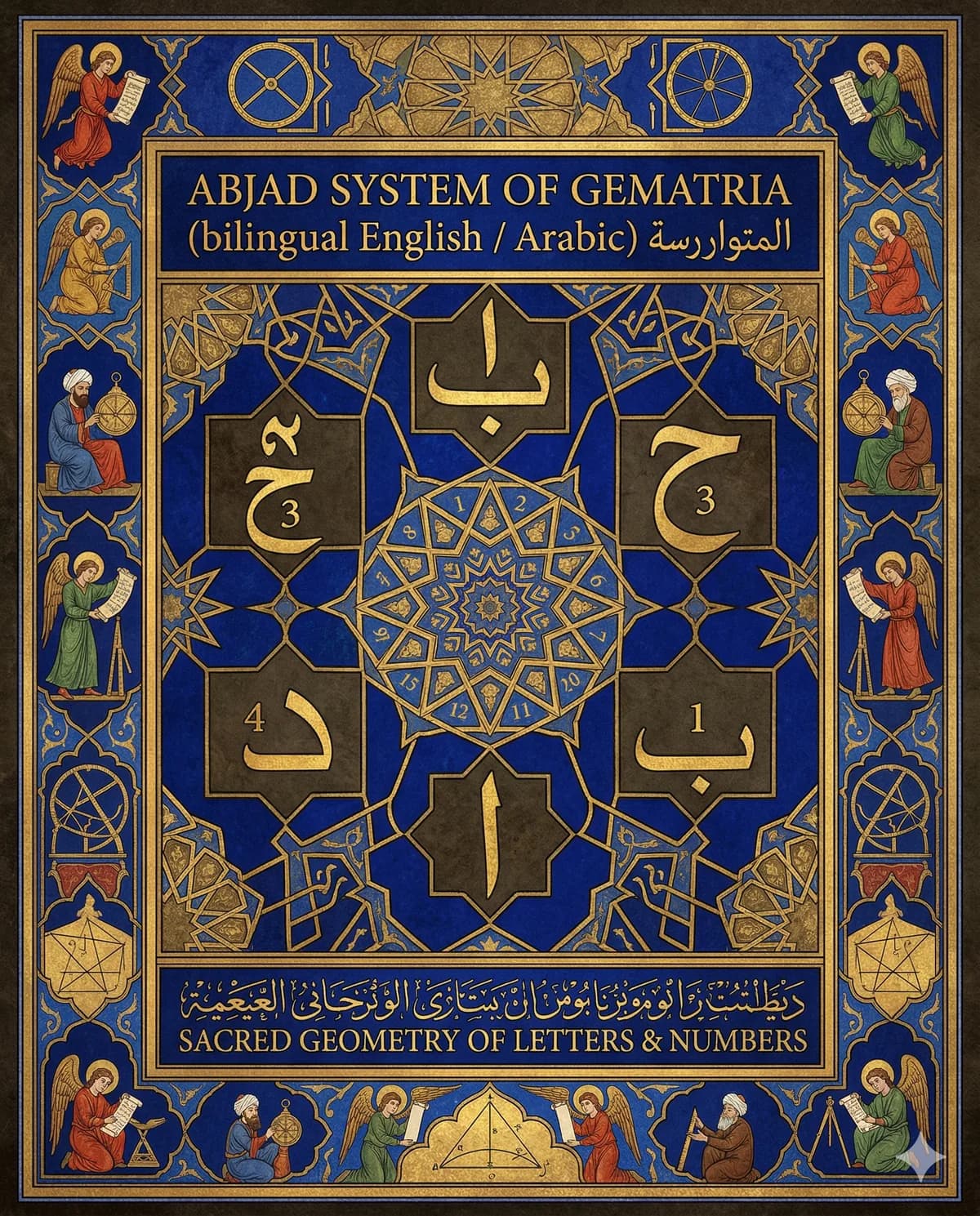
Abjad
أبجد · Abjad (Arabic)
RU: Абджад
Abjad (Arabic أبجد, abjad) is a system of numerical values of letters in the Arabic alphabet, the order of which goes back to the ancient Semitic (Phoenician) alphabet.
Origin of the name. "Abjad" is a mnemonic of the first four letters in the old order: أ (alif, 1) + ب (ba, 2) + ج (jim, 3) + د (dal, 4).
The Full Table of Numerical Correspondences (Hisab al-Jummal, حساب الجُمَّل)
Units:
- أ=1, ب=2, ج=3, د=4, ه=5, و=6, ز=7, ح=8, ط=9
Tens:
- ي=10, ك=20, ل=30, م=40, ن=50, س=60, ع=70, ف=80, ص=90
Hundreds:
- ق=100, ر=200, ش=300, ت=400, ث=500, خ=600, ذ=700, ض=800, ظ=900, غ=1000
Use in Arabic Numerology
Calculation of names and words. In Arabic numerology (#31), Abjad is used to compute the numerical value of names, words and phrases of the Quran. The Hisab al-Jummal method is the foundation of Ilm al-Huruf (علم الحروف — "the science of letters").
Analogs in Other Traditions
- Hebrew Gematria (#17, גימטריה) — for Hebrew
- Greek Isopsephy (ἰσοψηφία) — for Greek
Historical Significance
Before Indo-Arabic numerals. Historically, Abjad was used before the introduction of Indo-Arabic numerals for recording numbers in scientific, legal and astronomical texts. Each letter of the Arabic alphabet was simultaneously a sound and a number.
Translation note
Retain as 'abjad'. Distinguish from Gematria (#17): same structural principle (letter-number mapping), but ontologically grounded in Islamic understanding of Arabic as sacred language.
False friends / common mistakes
- ·
Gematria (Kabbalah #17) — analogous principle, Hebrew letters, different ontology
Term Info
Cluster Semitic / Arabic
Script Arabic