I Ching
The I Ching, or "Book of Changes", is one of the oldest surviving texts of Chinese civilization, dating to approximately the eighth–seventh centuries BCE, though its roots reach even deeper.
From divination to philosophy. Originally a divination practice, it became a foundational philosophical text consulted by Confucius, Daoist thinkers, and generations of Chinese scholars. In the West, the system became widely known after Richard Wilhelm's translation (1924), which drew the attention of Carl Jung.
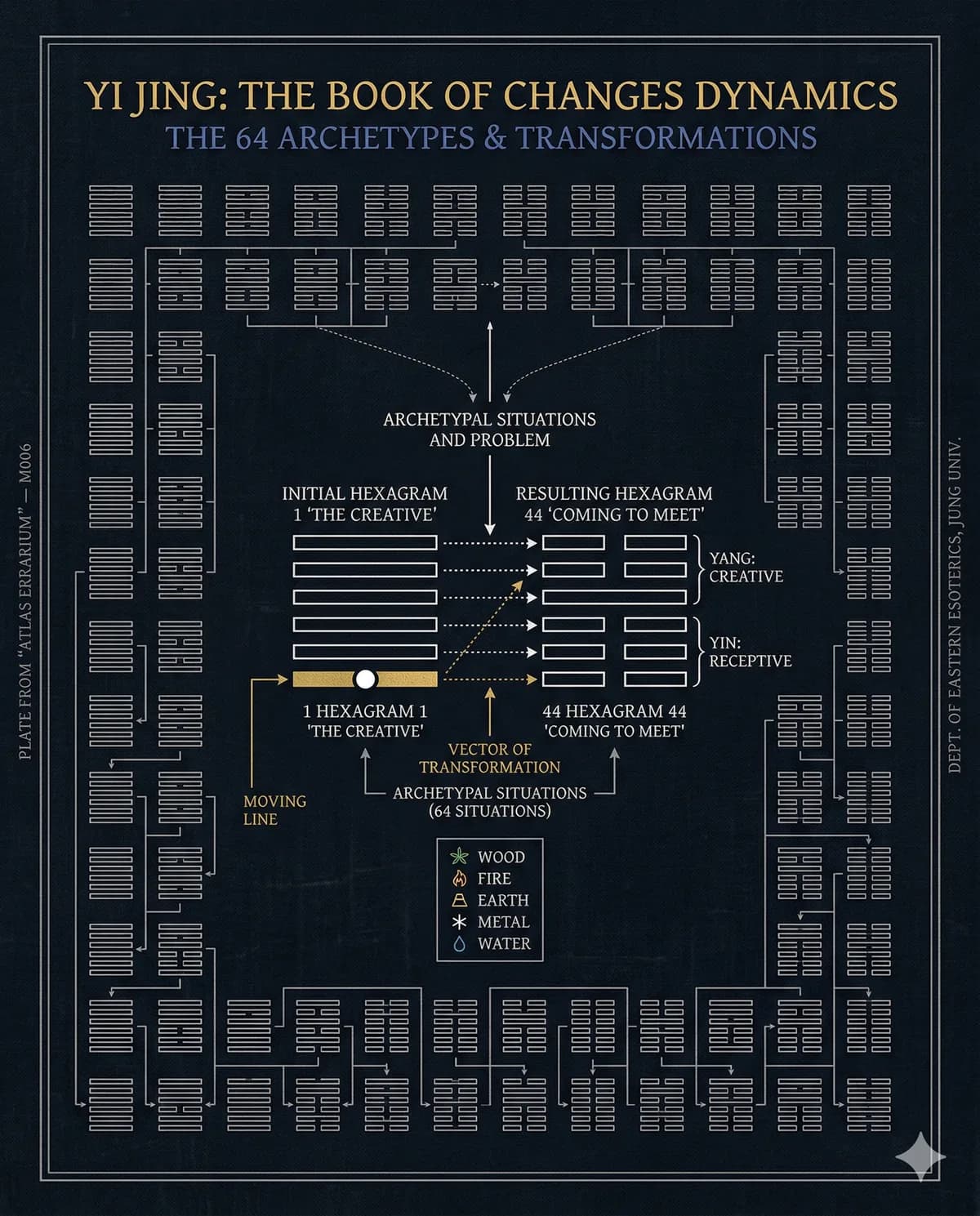
The Core — 64 Hexagrams
At the core of the system are 64 hexagrams, each composed of six lines: solid (yang) or broken (yin).
Randomness as resonance. A hexagram is obtained through tossing coins or sorting yarrow stalks, and this random process is understood as a resonance with the present moment of the situation.
Each hexagram has:
- A name
- A core image
- An extended commentary describing the quality of the moment, its dynamics, and the possible direction of development
The Philosophy of Continuous Change
Nothing is static. The philosophy of the I Ching is built on the idea of continuous change: no situation is static, and every phenomenon moves toward its opposite.
Moving lines. Moving lines point to a transitional hexagram — an image of what the situation is transforming into.
Not prediction, but orientation. The method does not predict specific events in the Western sense; rather, it describes the quality of the current moment and offers guidance for action or non-action.
Place in Errarium
A symbolic-cyclic system. In the Errarium atlas, the I Ching belongs to symbolic-cyclic systems: it works with archetypal images (64 situations as a complete set of possible states of the world) and with the cyclic logic of change fundamentally different from linear cause-and-effect thinking.
The Chinese analog of Tarot. This makes it the closest analogue to Tarot in the Chinese tradition — despite all the differences in cultural contexts and working mechanisms.
Method Info
Cat.  Symbolic
Cult. Chinese
D D1+D3
C C2+C3
T T0+T1
F F2, F3, F4