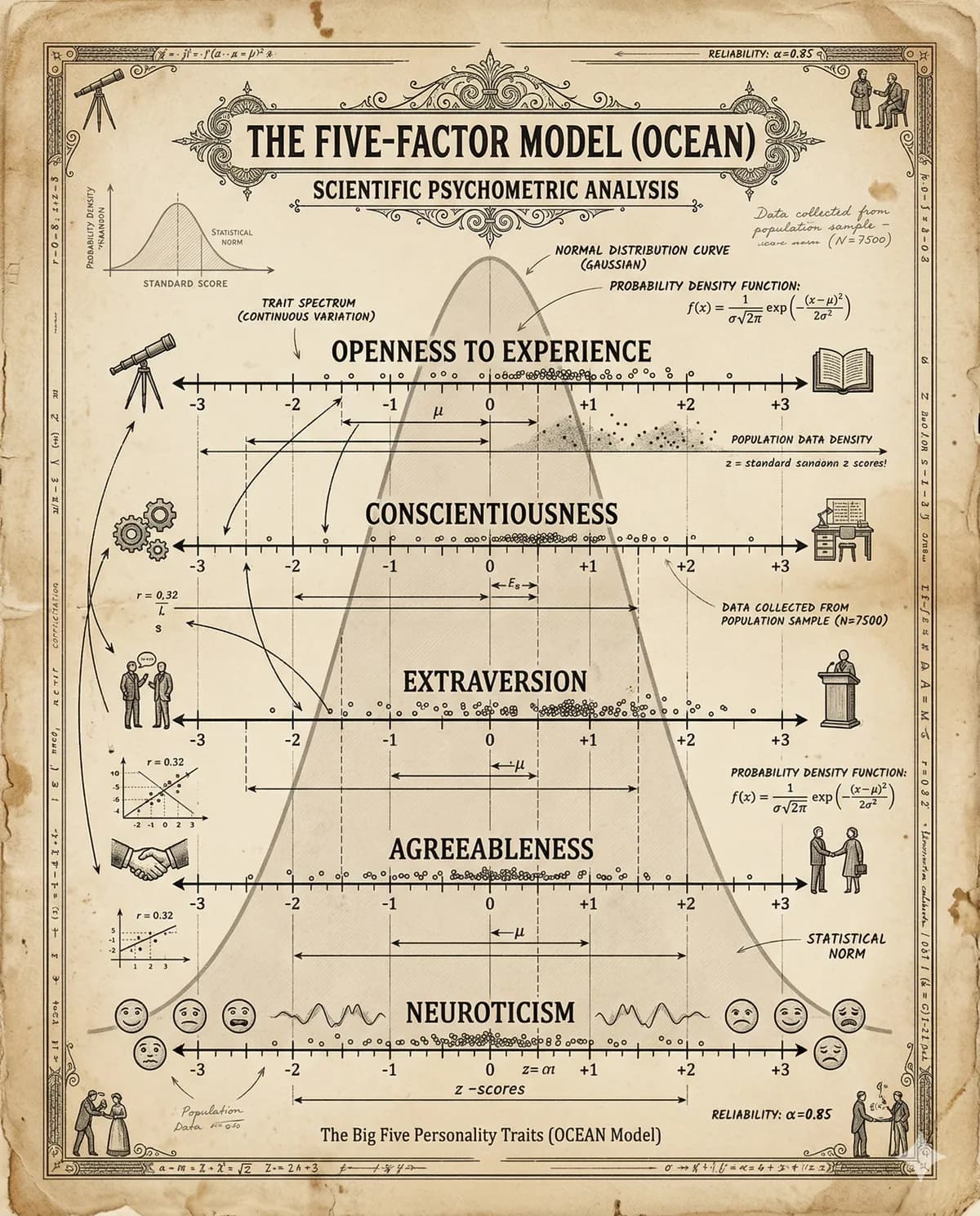
Big Five (Five-Factor Model)
The Five-Factor Model, or Big Five, is a product of twentieth-century academic psychology.
The story of discovery. Between the 1930s and 1960s, researchers noticed that a systematic analysis of adjectives describing people across different languages consistently yielded five stable factors. Independent groups of scholars — Warren Norman, Paul Costa, Robert McCrae, and others — obtained the same result time and again, which became the basis for considering the model universal.
The Five Factors
- Openness to Experience — curiosity and creativity
- Conscientiousness — organization and reliability
- Extraversion — social engagement and stimulus-seeking
- Agreeableness — cooperativeness and trust
- Neuroticism — emotional instability
Not categories, but scales. A crucial point: these are not categories but continuous scales. A person does not "be an extravert" — they score a certain value on the extraversion scale relative to the norms of their culture and age group.
Instruments and Stability
The method relies on formalized questionnaires (NEO-PI-R, BFI, and others) whose results lend themselves to statistical analysis and are reproducible upon retesting.
Dynamics with age. Traits are fairly stable, though they shift with age: conscientiousness tends to increase, and neuroticism on average decreases.
Predictive validity. Confirmed for academic achievement, professional performance, and relationship quality.
A Unique Place in Errarium
The only scientifically verifiable system. In the Errarium atlas, Big Five occupies a unique position: it is the only system with a high level of scientific verifiability. It does not describe "destiny" and does not appeal to archetypes or the cosmos — it measures what is statistically observable.
A fundamental difference from astrology. This makes it a valuable reference instrument for comparison with other methods, yet fundamentally different in nature: where astrology seeks symbolic correspondences, Big Five seeks mathematical regularities.
Method Info
Cat.  Psychological
Cult. Western (academic psychology)
D D0
C C0+C1
T T3
F F1, F2, F4