
Palmistry (Chiromancy)
Palmistry is one of the oldest systems of bodily interpretation, known in India, China, and the Middle East since deep antiquity.
The path to Europe. It reached Europe through Arab scholars and flourished during the Renaissance, when authors such as Cheiro (Louis Hamon) systematized it into elaborate schools. In the twentieth century, interest persisted both in popular culture and in the marginal academic study of dermatoglyphics.
Layers of Information
The method works with several layers of information:
- The major lines — life, head, heart, and fate — are read by length, depth, continuity and special markings
- The shape of the hand (square, conic, spatulate, philosophic) — corresponds to temperament
- Length and shape of fingers, proportions of phalanges, mounts beneath the fingers — each element adds nuance
Dermatoglyphics. The scientific study of skin ridge patterns confirms that papillary lines form in utero and are linked to genetic factors, though a causal connection to destiny remains beyond the scope of verifiable science.
The Left and Right Hand
The given and the lived. Within the tradition, the hand is understood as an imprint of the entire being:
- The left hand — innate potential
- The right — what the person has made of it
This makes palmistry one of the few systems that claims to read not only what is "given" but also what has been "lived".
Dynamic, not fatalistic. Lines, practitioners maintain, change over the course of a lifetime — transforming palmistry from a fatalistic system into a dynamic one.
Place in Errarium
A bodily method. In Errarium, palmistry is classified as a bodily method: the data source is the physical characteristics of the body rather than symbolic calculations or questionnaires.
The body as a biographical map. This brings it close to somatotypology and applied kinesiology in terms of data type, while its interpretive logic is entirely different: here the body is read as a biographical and archetypal map.
Method Info
Cat. 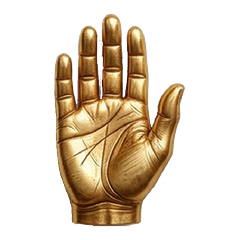 Somatic
Cult. Eastern / Western (syncretic)
D D2
C C3
T T3
F F1, F2, F3