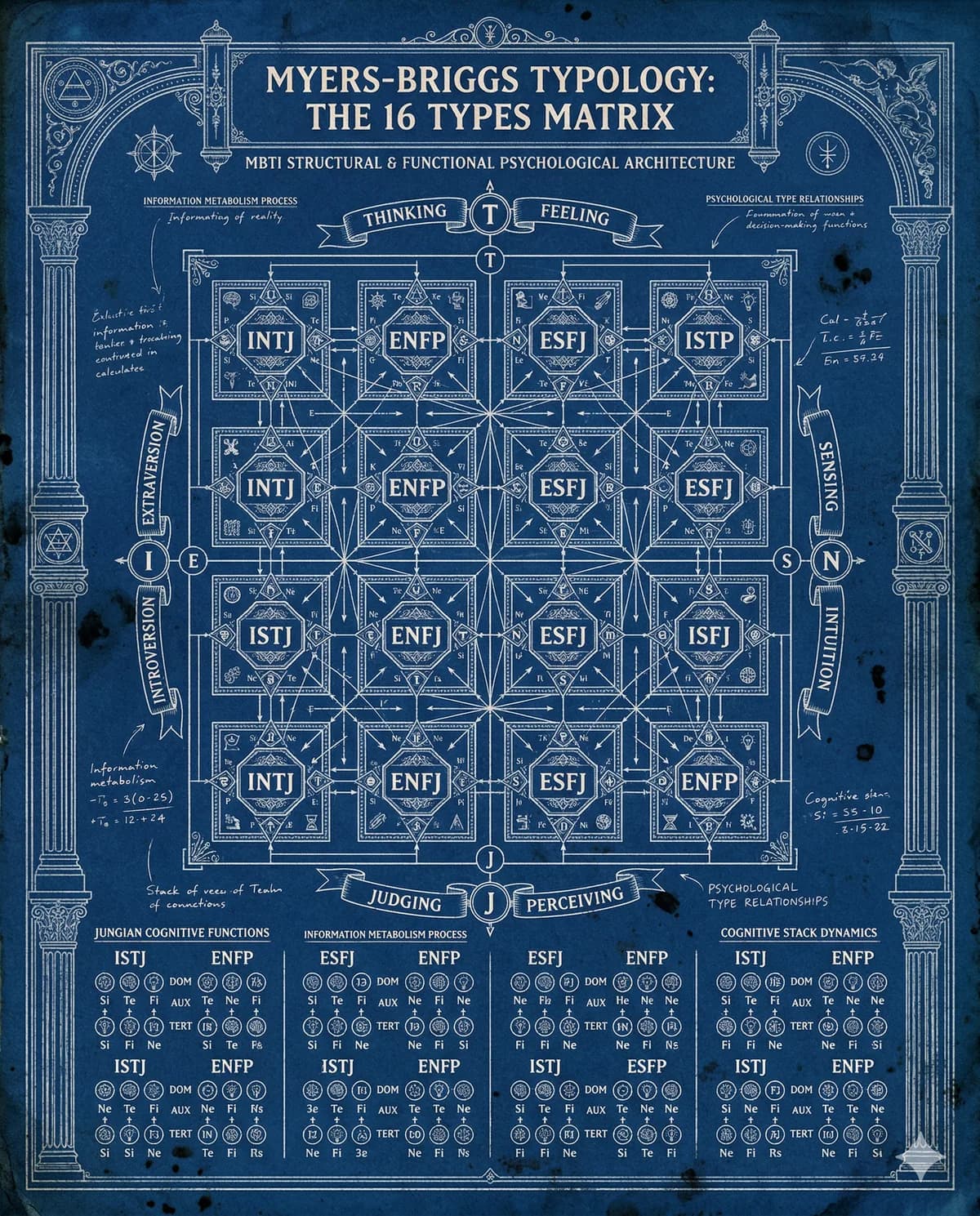
MBTI (Myers–Briggs Type Indicator)
The Myers-Briggs typology emerged in the mid-twentieth century as an attempt to make Carl Jung's theory of psychological types accessible and practical.
Authors of the system. Isabel Myers and her mother Katharine Briggs spent decades developing a questionnaire that would allow identifying a Jungian type without deep theoretical knowledge. The result was a system of 16 types designated by four-letter codes: INTJ, ENFP, ISFJ, and so on.
The Four Dichotomies
The dichotomies describe preferences rather than abilities:
- Introversion / Extraversion (I/E) — where a person draws energy
- Intuition / Sensing (N/S) — what they rely on when perceiving information: patterns and possibilities or concrete facts and details
- Thinking / Feeling (T/F) — how they make decisions: through logic or through values
- Judging / Perceiving (J/P) — how they structure their relationship with the outer world: planned and organized or flexible and open
Cognitive Functions
The function stack. Each of the 16 types has a characteristic "stack" of cognitive functions — the order in which different modes of information processing are engaged.
Depth of the model. This gives the model additional depth: two people with different types may behave similarly on the surface yet operate in fundamentally different ways internally. Type stability is relative: the maturity of functions changes with age and life experience.
Popularity and Criticism
A dual reputation. MBTI is one of the most popular instruments in corporate settings and popular culture, which simultaneously attests to its accessibility and creates risks of oversimplification.
Academic critique. Academic psychology views it critically: retest reliability is modest, and the dichotomies artificially split what in reality is a spectrum.
Place in Errarium
Between Jung and Big Five. Within Errarium, MBTI is treated as a typological system with an authored foundation — valuable for self-knowledge but fundamentally distinct from statistical models such as Big Five.
Method Info
Cat.  Psychological
Cult. Western (academic psychology)
D D0+D3
C C1
T T3
F F1, F2, F4