Numerology: Pythagorean School
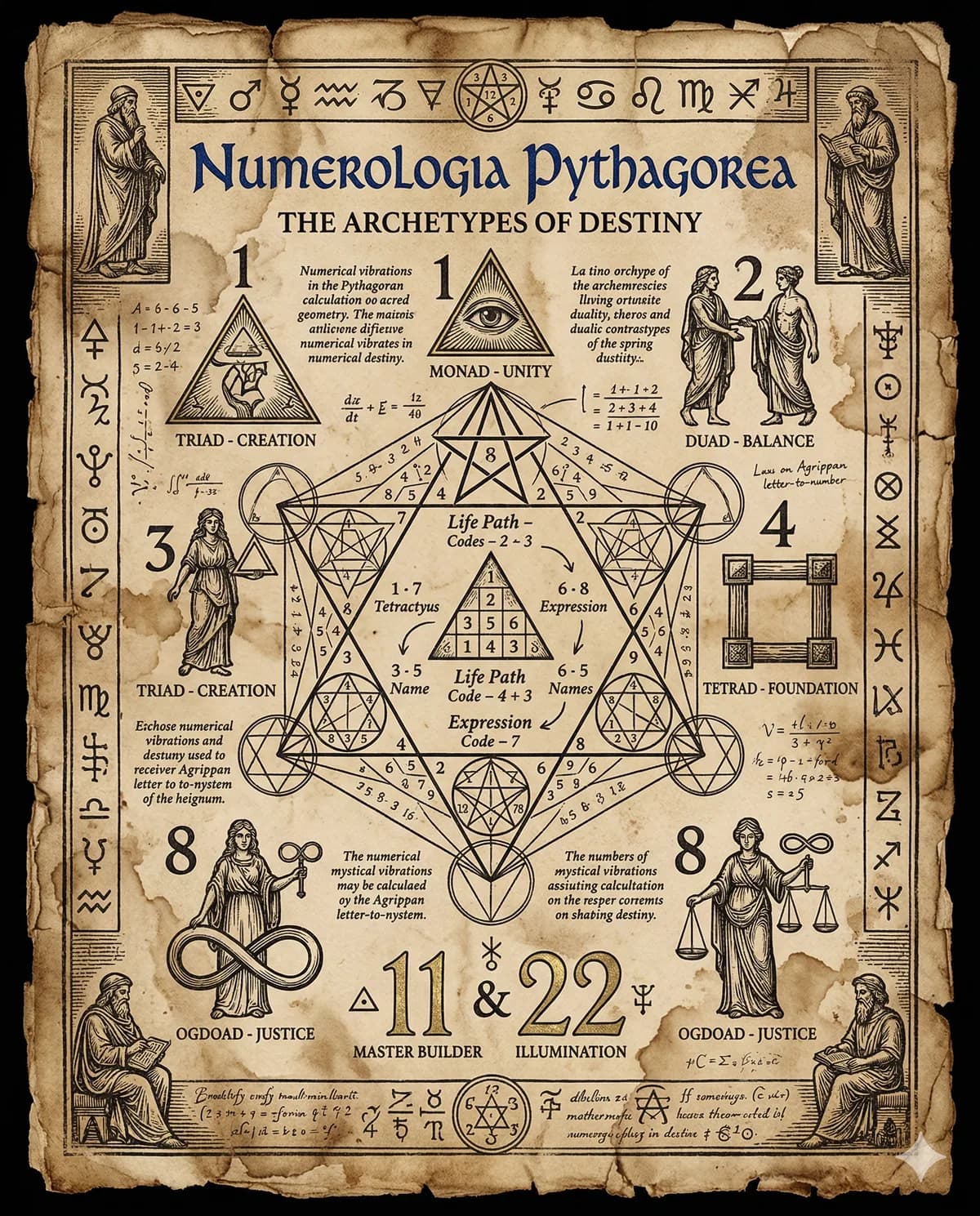
The Pythagorean school of numerology traces its origins to the philosophy of ancient Pythagoras, who held that numbers lie at the foundation of the universe.
The modern form. In its modern form — as a practice of calculating "destiny numbers" — the system took shape in the West during the nineteenth and twentieth centuries and was actively popularized by authors such as Linda Goodman and Dan Millman.
Alphabet and arithmetic. It uses the Latin alphabet with numeric correspondences and relies on the simple arithmetic of reducing multi-digit numbers to single digits.
Two Sources of Calculation
The main calculations are built on two sources: the date of birth and the full name at birth.
- Life Path Number — from the date; the central characteristic of the karmic task and primary direction of development
- Expression (Destiny) Number — from the full name
- Soul Number — vowels only
- Personality Number — consonants only
Archetypes of 1–9
Each number from 1 to 9 (plus the master numbers 11, 22, 33) carries a stable archetypal meaning:
- 1 — beginning and self-sufficiency
- 2 — partnership and duality
- 3 — creativity and self-expression
- 9 — completion and universality
The Nature of the Method
Pure symbolism. The method works with pure symbolic numbers — not their physical or statistical value, but the meaning that tradition has assigned to each.
Simple arithmetic, art of interpretation. Such calculations are easily verifiable arithmetically, but interpretation remains an art dependent on the numerologist's knowledge and intuition.
Place in Errarium
The Western symbolic approach. In the Errarium system, Pythagorean numerology represents the Western symbolic approach to numbers, as distinct from the Chaldean (#29), Vedic (#30), and Arabic (#31) schools — each of which employs different alphabetic correspondences and a different ontological logic.
The common principle of all numerologies. What unites all numerological systems is a foundational principle: a name and date of birth carry within them a symbolic key to understanding a person and their path.
Method Info
Cat.  Numerological
Cult. Western / Greek
D D1
C C3+C2
T T2+T3
F F1, F2, F3, F4