Ba Zi (Four Pillars of Destiny)
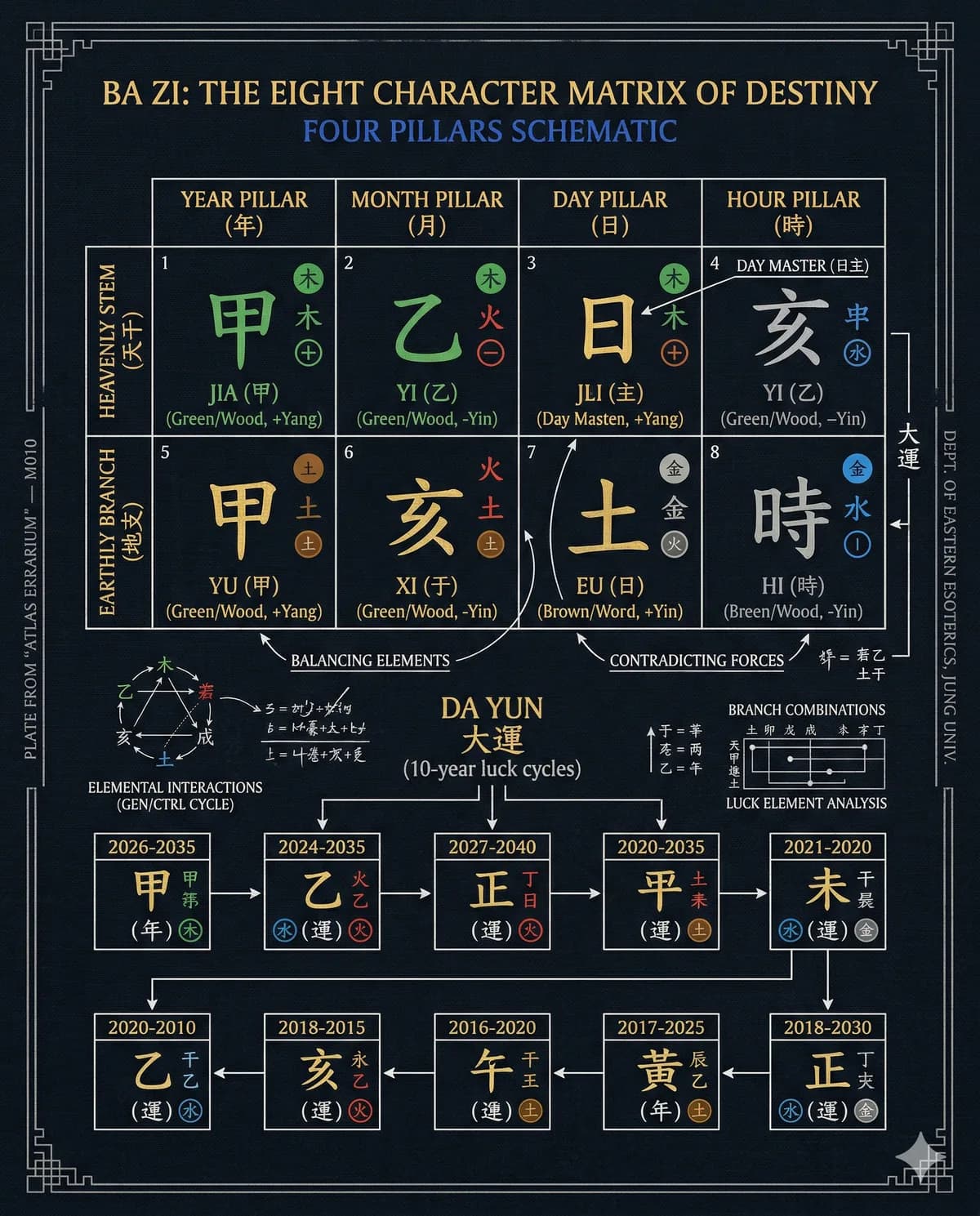
Ba Zi (八字, "eight characters") is one of the key systems of Chinese metaphysics, also known as the "Four Pillars of Destiny".
Origins. Its theoretical foundations took shape over the Tang and Song dynasties (7th–13th centuries), and its modern form was established through the work of Master Zi Ping in the tenth century. The system is widely practiced in China, Taiwan, Singapore, and Chinese diaspora communities around the world.
The Four Pillars of Destiny
The four pillars — year, month, day, and hour of birth — are expressed in terms of the Ten Heavenly Stems (天干, Tiangan) and the Twelve Earthly Branches (地支, Dizhi).
Eight characters and five elements. Each of the eight characters carries one or more of the five elements (wood, fire, earth, metal, water) in a particular interaction. The balance or imbalance of these elements in the chart determines the "commanding" element and reveals which forces strengthen or weaken the individual.
Life Dynamics — the Great Luck Cycles
Life dynamics are described through the Great Luck cycles (大運, Da Yun) — ten-year periods that succeed one another from childhood to old age.
Forecasting through layers of time. Each period activates a specific elemental pattern and overlays with annual transits (流年, Liu Nian). This allows the system to construct a detailed temporal forecast — describing the quality of decades and individual years, favorable and challenging phases in career, relationships, and health.
Place in Errarium
A structural analog of astrology. In the Errarium atlas, Ba Zi is a structural analog of Western astrology (#1) and Jyotish (#18) in terms of data type (symbolic parameters of the moment of birth) and function (diagnosis, interpretation, forecast).
A fundamental difference. Yet its ontology and mechanism are fundamentally different: instead of planetary archetypes — transformational phases of the five elements; instead of the tropical zodiac — the lunisolar Chinese calendar.
Method Info
Cat.  Astrological
Cult. Chinese
D D1
C C2+C1+C3
T T0+T2+T3
F F1, F2, F3, F4